
FEWER ADJECTIVES, MORE FACTS: why “quality service” fails to convince
“The highest quality”, “Individual attention”, “Advanced solutions”, “Experienced specialists”.
We see phrases like these in marketing every day. And no, they are certainly not wrong! In most cases, companies really do strive to deliver quality, invest in technology and take care of their clients.
The problem is that these phrases show almost nothing.
After reading that a clinic takes an individual approach, a patient still doesn’t know what that approach will look like. Will the consultation take longer? Will the doctor offer several treatment options? Will the person’s fears, financial means and expectations be taken into account?
Until there are answers to these questions, an “individual approach” remains just a nice-sounding adjective.
Free consultation

Žygimantas Kvartūnas
CEO & CMO
- Tel. +370 686 62 078
- Email zygimantas@expertmedia.lt
What if we tried something different?
After the consultation, let’s give the patient not a single instruction but several treatment options – explaining the course of each, its duration, cost and what can be expected in each case. Now the experience becomes something one can picture.
This is what can be called the principle of a tangible message: instead of saying what we are like, we show a fact, an action or a situation that proves it.
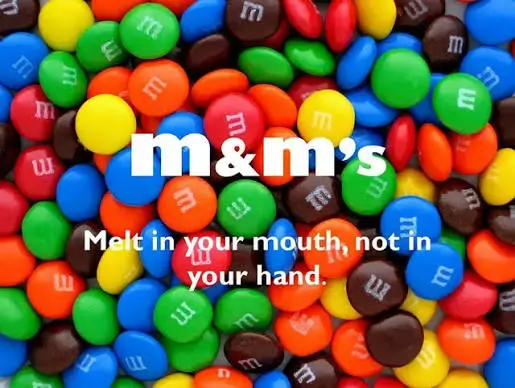
M&M’s: melts in your mouth, not in your hand. The slogan avoids abstract adjectives and at the same time addresses a problem the consumer may never have consciously thought about: eating chocolate can leave your hands messy.
People don’t buy the word “quality”
The word “quality” is not a feature of a product or service until we explain what it consists of.
For one person, quality dental care means a long-lasting result. For another – unhurried treatment. For a third – clear communication, aesthetics or the opportunity to find all the specialists they need in one place.
That is why abstract adjectives often shift all the work onto the audience. People have to decide for themselves what the brand meant. In marketing, this is risky. They may understand the message differently than we expected. Or not give it any weight at all.
In medical communication, people need clarity, not grand promises
Dental and medical services differ from most everyday purchases. A person often cannot assess the future result on their own in advance. They may be in pain, feel fear or embarrassment, or not know what kind of treatment they need at all.
In such a situation, phrases like “the highest standards” or “flawless results” rarely answer the most important questions:
- What awaits me at my first visit?
- Can the procedure be painful?
- How will the treatment method be chosen?
- How many visits might be needed?
- What if I’m afraid?
- When will I find out the price?
- Will the alternatives be explained to me?
The more uncertainty a person feels, the more valuable the details that help them understand the process become. So let’s not try to look impressive – let’s simply be useful.
The best message is often hidden in a company’s everyday routine
When creating an ad, the first thing people usually look for is a creative slogan, yet the strongest messages often already exist in a company’s processes – you just need to notice them.
For example, a clinic says “we are attentive to every patient”, but a conversation with the team reveals that before more complex treatment, the patient gets a call the next day asking how they are feeling.
Now that is an advertising message:
After a more complex procedure, we don’t leave the patient alone with an instruction sheet – the next day, a member of our team gets in touch to ask how they are feeling.
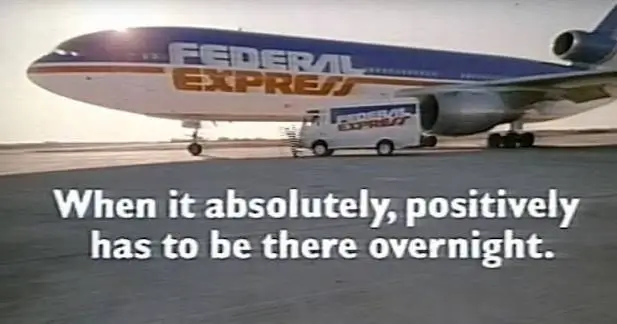
FedEx: not fast delivery, but overnight delivery. The 1978 campaign “Absolutely, Positively Overnight” did not say that the company “tries to deliver as quickly as possible”. It set a clear time limit by which the customer could judge the service.
Should we always speak only in facts?
No.
Abstract language can be very useful in building a brand’s mood, values and emotional identity. It helps to talk about who a person wants to become, how they want to feel or which group they want to belong to.
Some studies have found that more abstract messages can be more persuasive for consumers who know the field well, while more concrete ones work better for those who lack prior knowledge. More recent research also shows that the right level of language abstraction may depend on the category being advertised: broader emotional language may suit creative or artistic products, while products associated with science and technology call for more concrete language.
So there is no need to strip all emotion out of advertising.
How to turn an abstract phrase into a stronger message?
Let’s start with a conversation. We will help you discover the specific advantages of your business and turn them into advertising that not only sounds good but also gives people a reason to choose you.
Free
consultation
Our clients say that a 30-minute conversation saved them several months of trial and error.

Book a free consultation
Fill out the form, and within 30 minutes we’ll discuss your business situation, challenges, and potential growth strategies.